B2B Guide · For Importers & Buyers
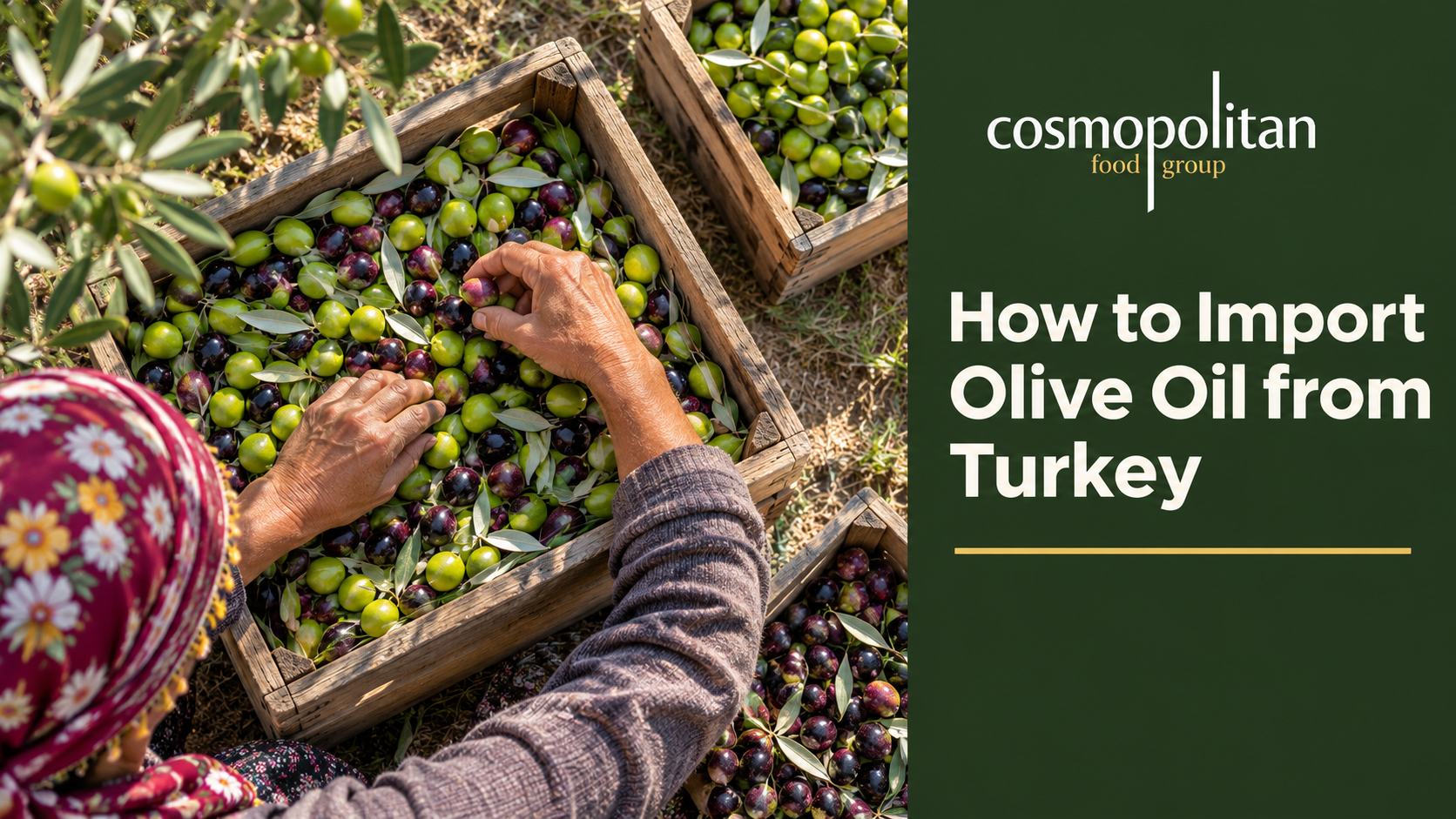
How to Import Olive Oil from Turkey: A B2B Guide
From choosing an Incoterm to clearing customs, here’s the full process of importing olive oil from Turkey — the documents you’ll need, the standards your shipment must meet, and the costs and timelines to plan for.
Quick answer
To import olive oil from Turkey: choose a verified exporter and agree the grade and Incoterm (FOB, CFR or CIF are common); confirm quality with a batch Certificate of Analysis and a sample; prepare the core customs documents (commercial invoice, packing list, certificate of origin, health certificate, and EUR.1 for the EU); book sea freight, usually from İzmir or Aliağa; and clear customs in your country — in the US this also means FDA food facility registration and prior notice. Budget for product, freight, duty, inspection and a customs broker.
The import process, step by step
- Select and vet the exporter Confirm grade, certifications and references. See our guide on choosing the right olive oil supplier.
- Agree terms & Incoterm Lock the grade spec, price, packaging and the Incoterm that defines who handles freight, insurance and risk.
- Verify quality Request a batch COA from an accredited lab plus a pre-shipment sample; for large orders, arrange independent inspection.
- Prepare documents Collect the commercial and transport paperwork (full checklist below) and any destination-specific filings.
- Book freight Arrange sea transport — flexitank, IBC totes or drums — typically loading at İzmir or Aliağa.
- Clear customs & receive Your customs broker files the entry, duties are paid, and the goods are released.
Choosing the right Incoterm
The Incoterm decides exactly where the seller’s responsibility ends and yours begins. These are the ones most used for olive oil shipments:
| Incoterm | Who arranges main freight | Good when |
|---|---|---|
| EXW | You (from the factory) | You have a freight forwarder and want full control |
| FOB | You (from the Turkish port) | Most common; seller delivers to port, you ship |
| CFR | Seller (freight), you insure | You want the seller to book ocean freight |
| CIF | Seller (freight + insurance) | Simplest for newer importers |
| DAP | Seller (to your location) | You want door delivery; you still clear customs |
Definitions are standardised by the ICC Incoterms® 2020 rules, so name the exact term and year in your contract (e.g. “FOB İzmir, Incoterms® 2020”). More on the logistics side in our olive oil export from Türkiye guide.
Documents & customs paperwork
Most olive oil imports require this core document set. Confirm the exact list with your customs broker for your country:
- Commercial invoice — value, grade, quantity, Incoterm.
- Packing list — units, weights, packaging format.
- Bill of lading — the ocean carrier’s transport document.
- Certificate of origin — proves Turkish origin.
- Health / sanitary certificate — food-safety clearance for export.
- Batch Certificate of Analysis (COA) — quality parameters for the lot.
- EUR.1 movement certificate — for preferential EU tariff treatment, where applicable.
Tip: get draft copies of every document before shipment so errors are caught before the container sails — corrections after departure cause the most costly delays.
Quality & standards compliance
Your shipment must match both the grade you ordered and the rules of the market you sell into:
- Grade & purity — internationally, olive oil grades and limits (e.g. extra virgin free acidity ≤ 0.8%) follow the International Olive Council trade standard. Have the COA confirm your grade.
- Labeling — your retail label must meet destination rules (EU olive oil marketing standards, or US nutrition-label format).
- United States — the exporting facility needs FDA food facility registration and you must file prior notice; see the FDA’s overview of importing human foods.
- Organic / Halal / Kosher — matching certificates must accompany the goods if you make those claims.
Costs to budget for
- Product cost (moves with each harvest — ask if your price is fixed or market-indexed)
- Ocean freight and, depending on Incoterm, insurance
- Import duty and any taxes in your country
- Customs broker and clearance fees
- Third-party inspection or lab testing (recommended for large orders)
- Inland transport and storage at destination
How long does it take?
Plan around three phases: order and production (varies by volume and whether oil is in stock), ocean transit (often a few weeks depending on destination), and customs clearance on arrival. Building in time for document checks and inspection avoids the delays that catch first-time importers.
Red flags to avoid
- A supplier who can’t provide a batch COA or standard export documents.
- Prices far below market — a classic sign of adulteration or mislabeled grade.
- Vague answers about the harvest year or loading port.
- No recognised food-safety certification (ISO 22000 / HACCP as a baseline).
- Pressure to skip samples or pre-shipment inspection.
Frequently asked questions
How do I import olive oil from Turkey?
What documents are needed to import olive oil from Turkey?
What Incoterms are used for olive oil imports?
Do I need FDA registration to import olive oil into the US?
What quality standards apply to imported olive oil?
How long does it take to import olive oil from Turkey?
Importing olive oil from Turkey?
Cosmopolitan Food Group is a certified Turkish exporter supplying bulk, packaged and private-label olive oil, with export documentation handled end to end. Request grades, terms and a quote.
Incoterms® is a registered trademark of the International Chamber of Commerce. This guide is general information, not legal or customs advice — confirm requirements for your specific market with a licensed customs broker.